8 Apr 12:00
REGISTRATION IS OPEN FOR THE
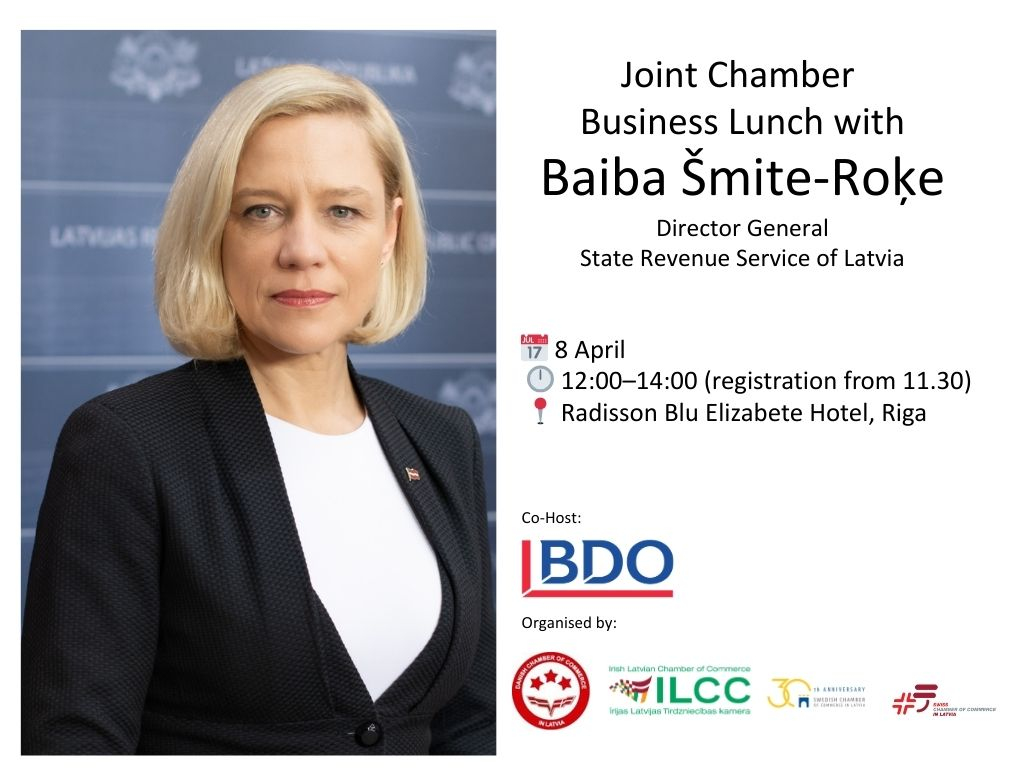
Joint Chamber Lunch Meeting with Baiba Šmite-Roķe, Director General of State Revenue Service of Latvia.
This lunch meeting will provide an excellent opportunity for members of the international business community to engage in an open discussion on tax administration, cooperation with the State Revenue Service, and the overall business environment in Latvia.
The event is jointly organized by the four Chambers and BDO, and will be moderated by Dr. Edgars Volskis, Head of Advisory at BDO Latvia.
If you have any specific questions, you would
like addressed during the discussion, please submit them by dcc@dcc.lv 2 April.
Date & Time: Wednesday, 8 April 2026, between 12:00 and 14:00 (registration from 11:45)
Venue: Radisson BLU Elizabete Hotel | restaurant, Elizabetes iela 73, Rīga
Type of event: IN PERSON | Joint Chamber Lunch meeting
Admission: 38 EUR p/p for DCCL members & organizing chambers | 50 EUR p/p for others
Registration: Please register with the Danish Chamber at dcc@dcc.lv by the latest APR 1 (Kindly include your name and company in the message for billing purposes).
All registrations are financially binding after APR 1.
About the guest speaker:
Baiba Šmite‑Roķe is the Director General of the State Revenue Service (SRS/VID) of Latvia, assuming office on 13 February 2024 following government approval earlier that year. She has worked at the State Revenue Service since 2000, building a long career in tax administration. Her roles have included Director of the Excise Goods Division (appointed in 2015), Deputy Director of the Tax Board (2020), and Director pro tempore of the Tax Board (2023).
She holds a Master’s degree in Economics from the University of Latvia (2007) and is pursuing a doctorate in economics and management at Riga Technical University.
As Director General, Šmite‑Roķe emphasizes reorganization, digitalization, customer‑oriented service, and combating the shadow economy as her key priorities. She promotes the modernization of tax administration and aims to strengthen public trust through more efficient and transparent processes